
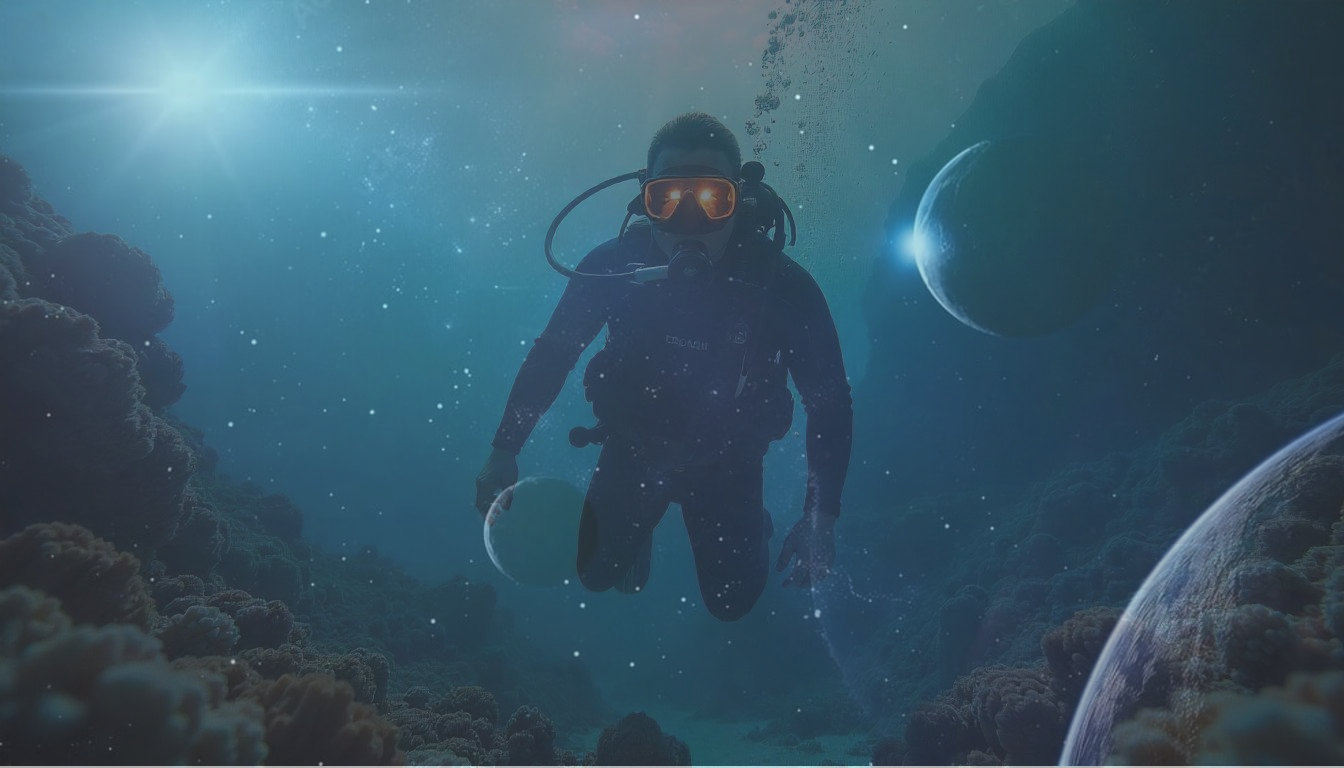
Training to operate in space is as exciting as it is challenging. How do we simulate space without going into it? The training requires not only a deep understanding of complex scientific principles but also hands-on experience in environments that mimic the conditions of outer space. One of the most effective ways to prepare astronauts for their journeys beyond Earth is through underwater diving simulations.
The underwater environment offers a unique set of conditions that closely resemble the challenges faced in space. Astronauts must adapt to microgravity, where every movement can have significant consequences. In space, the absence of gravity alters the way the body moves, affecting everything from muscle control to coordination. Underwater diving provides a controlled environment where astronauts can experience a degree of weightlessness, allowing them to hone their skills in a setting that simulates the sensation of floating in space.
Training in a submerged environment allows astronauts to develop a new understanding of buoyancy, which is crucial for functioning effectively in a microgravity scenario. Astronauts must learn how to manage their bodies and maneuver tools and equipment underwater, preparing them for similar tasks in space. The challenges of moving in a bulky spacesuit can be daunting, but practicing underwater enables trainees to navigate these challenges with increased confidence.
One notable example of this training strategy is NASA’s Neutral Buoyancy Laboratory (NBL) in Houston, Texas. This large pool is specifically designed for astronaut training, where they can rehearse complex tasks that require precision and coordination. The NBL is equipped with various tools, spacecraft models, and systems they will encounter in orbit. Astronauts often conduct EVA (extravehicular activity) simulations in this facility, practicing how to fix equipment or conduct experiments while submerged, which effectively mirrors the experience of working outside a spacecraft.
The psychological aspect of space training is just as important as the technical skills required. Underwater simulations also provide a space for astronauts to build strong teamwork and communication skills, essential for long-duration missions. The isolation and confinement of both underwater environments and spacecraft necessitate effective collaboration. By training together in challenging underwater settings, teams learn to trust and rely on each other in high-stress situations, much like they will in the confines of a space mission.
Moreover, undersea exploration itself has increasingly been recognized as vital for understanding more about life in extreme environments. The ocean is an isolated and hostile place, much like outer space. Studying marine biology, underwater ecosystems, and the effects of pressure on the human body plays an informative role in preparing astronauts for potential findings during their cosmic explorations.
While training in underwater environments cannot completely replicate every aspect of space travel, it provides a critical foundation for astronauts. The ability to practice essential skills in a microgravity-like setting allows for a smoother transition to actual space missions. As space agencies and private companies continue to advance their training protocols, the combination of underwater diving simulations with other training methods will undoubtedly enhance astronaut preparation, ensuring that explorers are as ready as possible for the challenges of their extraordinary journeys beyond our planet.
It is so cool to think we can do something as exciting as undersea diving and that teaches us about space. Likewise the reverse occurs when we head out into space, we learn more about the similar situations we may encounter back on earth.
Traveling in space, as in the case of undersea diving, opens our minds to the extremes – and limitations – of the human condition. And this helps us learn about our own mental and physical well-being. That connection to our everyday life becomes less and less tenuous the more we think about it.
This is why space – and the Alpha Centi – mindset is so important. We should get excited about space and its cross-application to our every day lives back on Earth.